
info@smarledlighting.com
+86 20 38466982
Toggle Navigation

By Dale Chaw | SMAR LED Lighting
Technical Review: SMAR LED Lighting Engineering Team
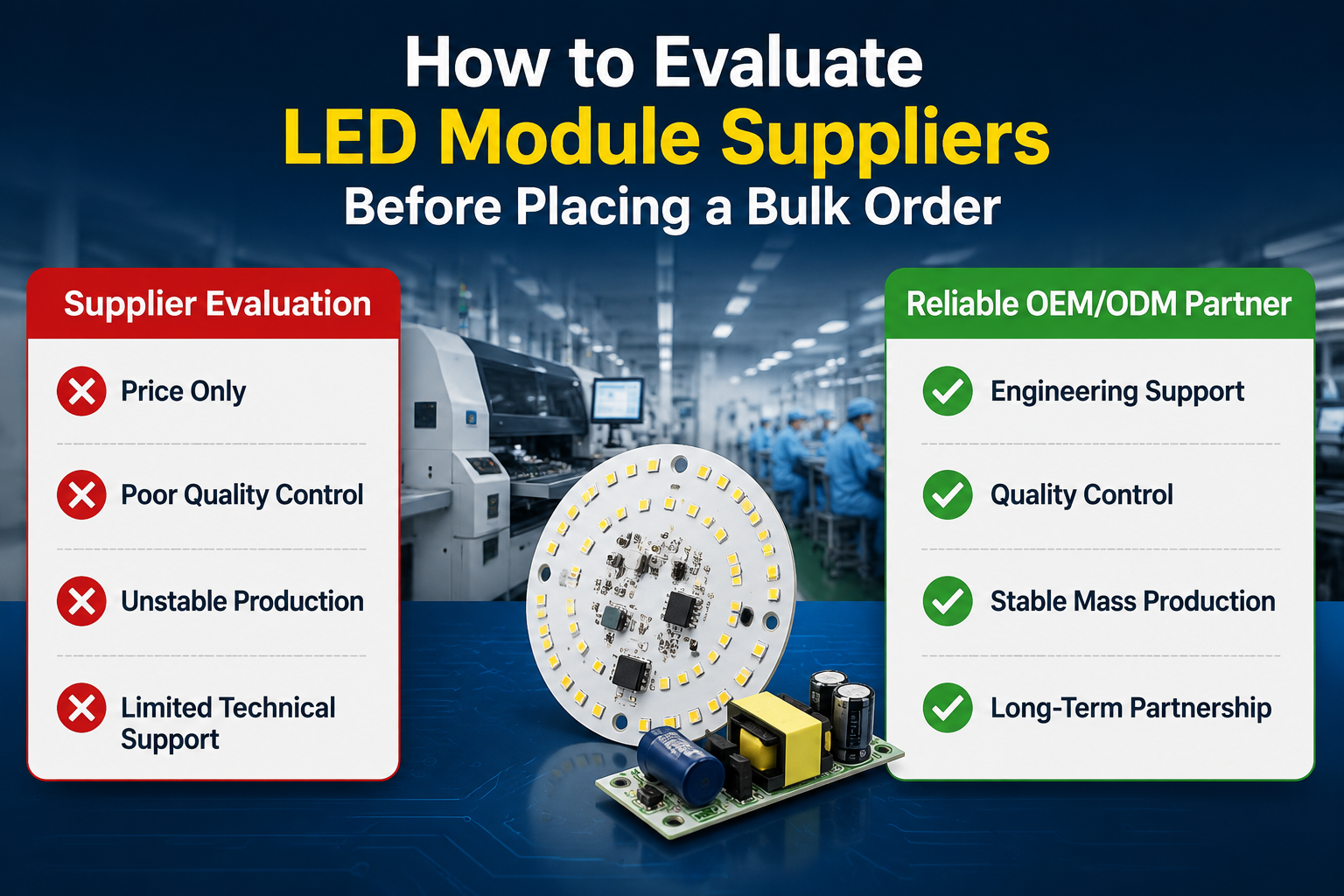
For lighting manufacturers, selecting an LED module supplier is a decision that directly affects product quality, production efficiency, and long-term business growth.
Many buyers start by comparing prices. But the lowest quotation rarely represents the lowest total cost. Problems caused by an unreliable supplier tend to surface later, once mass production is already under Our support including customizedway — inconsistent brightness between batches, color variation, thermal issues, flicker, product failures after installation, delayed delivery, or difficult technical communication. Switching suppliers after production has started is expensive: new samples, new testing, new production validation, inventory adjustments, and re-approval from your own customers.
That’s why evaluating an LED module supplier means looking past price to manufacturing capability, engineering support, quality control, testing capability, production consistency, and communication. A reliable supplier does more than manufacture products — it helps reduce development risk and gives you a stable foundation to build on.
This guide is a practical framework for lighting manufacturers evaluating an OEM/ODM LED module partner before placing a bulk order.
Since this guide refers to OEM/ODM partners throughout, it’s worth being clear about the distinction before going further.
OEM (Original Equipment Manufacturer) means the buyer supplies the design and specifications, and the manufacturer produces the product to those exact requirements. The buyer owns the design; the supplier is responsible for manufacturing it accurately and consistently.
ODM (Original Design Manufacturer) means the manufacturer also handles the design and engineering work. The buyer provides application requirements — target power, dimensions, performance targets — and the supplier’s engineering team develops the solution, which the buyer can then customize and purchase under their own brand.
Many lighting manufacturers work with a supplier across both models: OEM for products where the design is already finalized, and ODM for new products where engineering support is needed to develop the solution from scratch. The evaluation criteria below apply to both — but manufacturing capability and engineering support carry more weight for ODM relationships, since the supplier is doing more of the technical work.
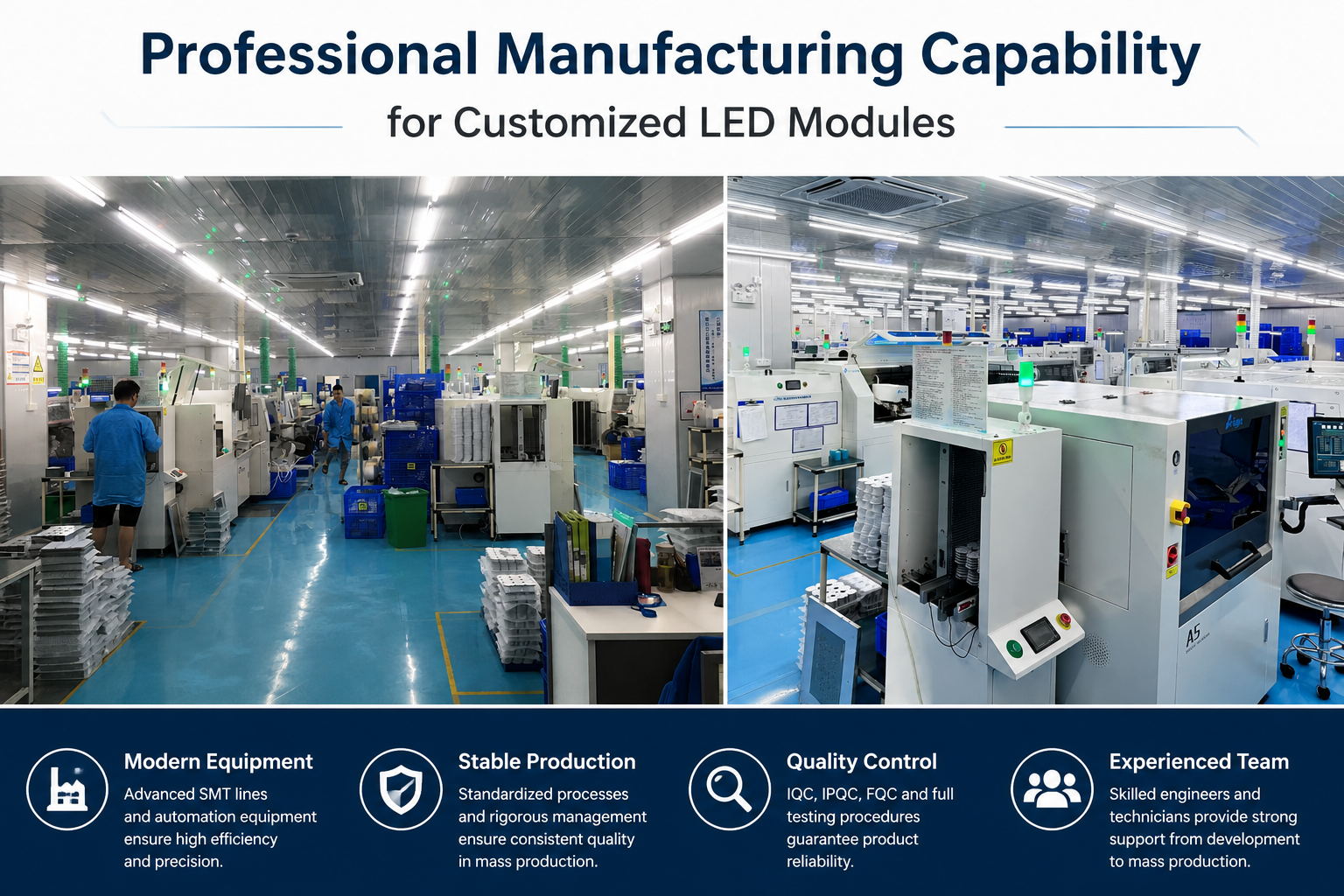
The first step in supplier evaluation is understanding whether the company has real manufacturing capability. A supplier may provide an attractive sample, but producing one good sample is very different from maintaining stable quality across mass production.
For bulk orders, that means looking at production equipment, manufacturing process, engineering capability, quality control, and production management. A capable LED module supplier should have experience handling the complete process from development through production — not just assembly.
LED modules aren’t simply assembled by placing LEDs onto a PCB. A successful design requires coordinating LED selection, PCB design, driver solution, thermal management, electrical performance, and mechanical requirements. Designing a compact DOB module, for example, means working through available PCB space, component arrangement, heat generation, input voltage requirements, efficiency targets, and flicker performance all at once.
A supplier that only focuses on assembly may not be equipped to solve these design challenges. An experienced OEM/ODM partner participates in development and offers technical input before production starts — not after problems show up.
At SMAR LED Lighting, customized LED module projects start with understanding the actual application requirements. Before production, our engineering team evaluates the required power range, PCB dimensions, LED quantity and arrangement, thermal conditions, electrical requirements, and application environment.
Different requirements lead to different technical solutions. A compact module calls for a different PCB layout than a higher-power one; a product headed for European markets needs closer attention to power factor, EMC performance, flicker control, and energy efficiency. This engineering evaluation is what helps customers land on a more suitable solution before committing to mass production.
【Internal Link: Customized LED Module Solutions: How SMAR LED Lighting Creates More Value for Lighting Projects】
The PCB is one of the most important parts of an LED module — it does more than provide electrical connection. It also affects heat dissipation, product lifetime, safety performance, and manufacturing reliability. When evaluating a supplier, check whether they actually understand the tradeoffs between different PCB solutions, rather than defaulting to one material for everything.
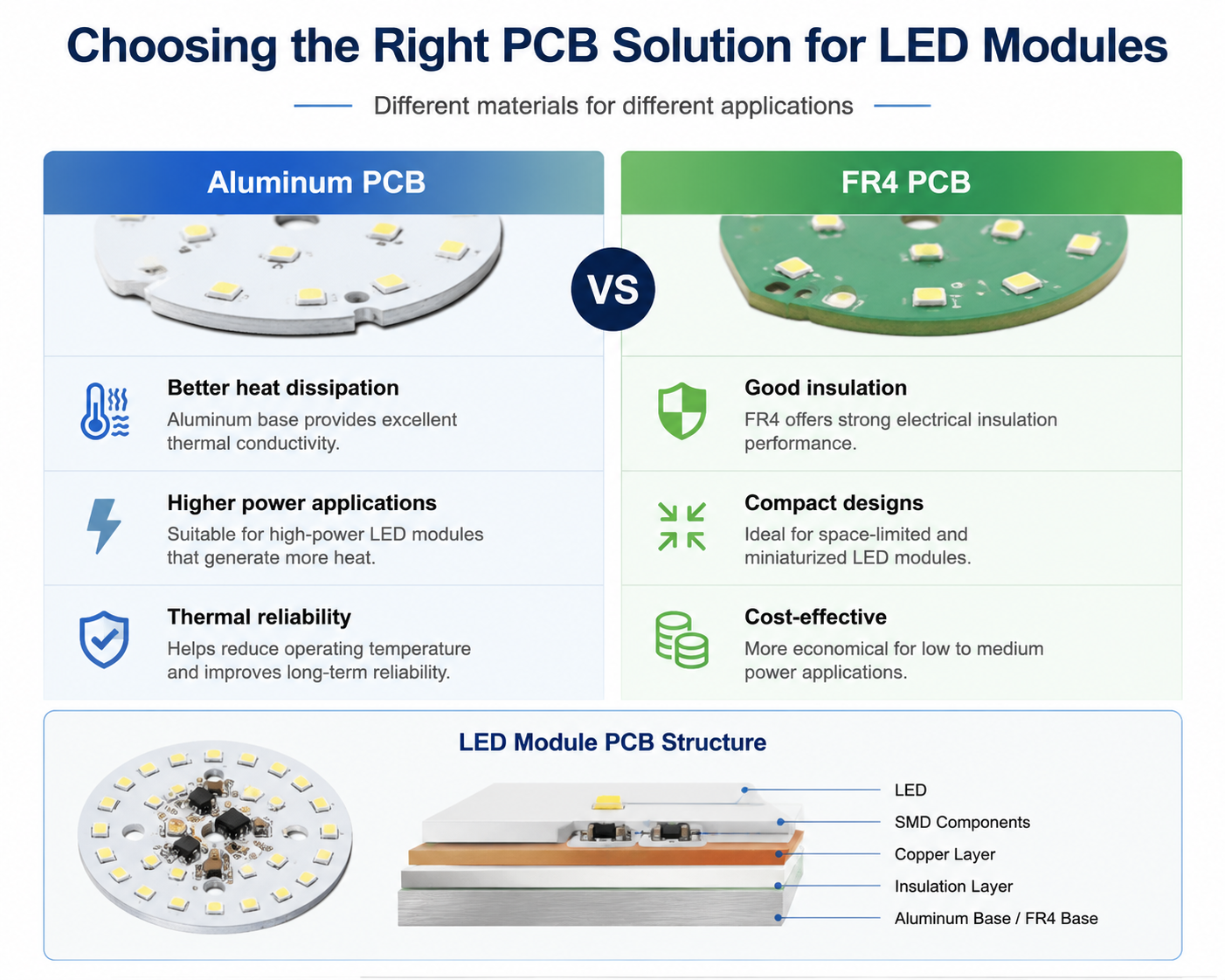
Aluminum PCB offers better thermal conductivity, making it well suited to higher-power LED modules where reducing operating temperature improves long-term reliability.
FR4 PCB offers good electrical insulation and cost-effectiveness, making it a reasonable choice for compact, lower-power, or insulation-focused designs.
A professional supplier evaluates power level, installation structure, heat dissipation conditions, cost requirements, and safety requirements before recommending a PCB solution — not the other way around.
【Internal Link: LED PCB Materials Explained: How to Choose the Best PCB for Different Lighting Applications】
For customized LED modules, PCB design takes more than drawing a circuit layout. Engineers need to account for current distribution, component placement, heat balance, electrical safety, and assembly efficiency — because poor PCB design shows up later as uneven brightness, higher operating temperature, shorter lifetime, production difficulty, and higher failure risk.
At SMAR, PCB design evaluation is part of every customized module project, and we look at whether a design can be produced consistently at volume — not just whether the prototype works. A successful prototype doesn’t automatically guarantee successful mass production.
Once PCB design is confirmed, manufacturing capability is the next factor. For LED modules — DOB modules especially — SMT (Surface Mount Technology) is a critical process, since many components need to be placed accurately within a limited PCB area. A stable SMT process directly affects electrical performance, product reliability, production consistency, and manufacturing efficiency.
When evaluating a supplier, check for automated SMT equipment, standardized production procedures, solder paste control, reflow soldering management, and a real production inspection process.
Why SMT Quality Matters for LED Modules
Small production differences during SMT assembly can meaningfully affect performance. Incorrect component placement can affect circuit performance; poor soldering can cause unstable electrical connections, early failure, or intermittent problems during operation. For DOB modules, the stakes are higher still, since driver components are integrated directly onto the PCB — the supplier needs to control placement accuracy, soldering quality, reflow temperature profile, and post-assembly electrical inspection all at once. A professional process is what keeps products consistent from the first batch through every batch after it.
At SMAR LED Lighting, customized LED modules move through a controlled, checkpoint-based manufacturing process:
1. Customer-approved component sourcing and IQC inspection
2. Material warehousing and production requisition
3. SMT printing and component placement
4. Reflow soldering and QC inspection
5. DIP insertion and wave soldering
6. Touch-up soldering, lead trim, and cleaning
7. QC parameter testing
8. Final assembly and a second round of QC parameter testing
9. Packaging and QA final audit
10. Finished goods warehousing and shipment
Each checkpoint exists to catch a specific category of problem before it reaches the next stage — which is what makes it possible to hold both standard and custom orders to the same reliability standard.
A reliable supplier verifies product performance through testing — not just a visual check of the finished product.
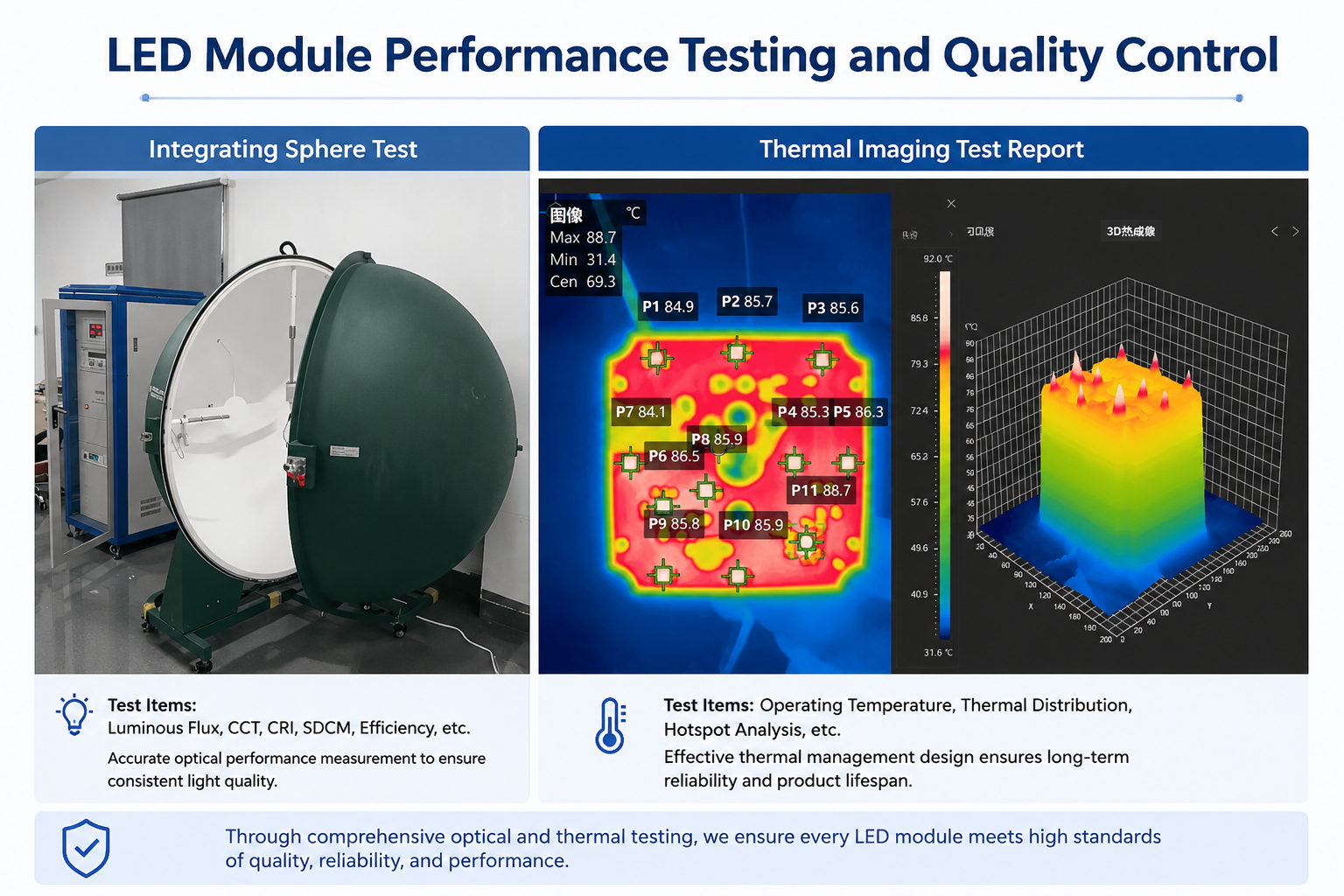
Electrical parameters are a core indicator of LED module reliability: input voltage, power consumption, current, power factor, and efficiency. Different markets have different requirements for power factor and energy efficiency, so during customized DOB module development, these parameters often need to be optimized for the customer’s specific target market.
Lighting manufacturers need consistent optical performance, since the finished product carries their own brand. That means verifying luminous flux, color temperature, color rendering index, and color consistency with proper testing equipment — not by eye.
Thermal management is one of the biggest factors in LED lifetime. During development, engineers should evaluate PCB temperature, component temperature, heat distribution, and real operating conditions. A module that performs well under laboratory conditions can still run into trouble if thermal behavior in the actual application wasn’t properly accounted for.
For international lighting markets, EMC and flicker performance matter more every year. Buyers increasingly need products that meet requirements around EMC performance, harmonic current, flicker control, and energy efficiency.
Certification is part of this picture too. Our LED modules can be designed and manufactured to meet international market requirements, including CE, RoHS, UL, and energy efficiency requirements such as ErP, depending on the target market and application.
At SMAR, customized LED module projects often mean balancing several requirements at once — compact size, high efficiency, stable electrical performance, low flicker, and cost control. Getting that balance right usually takes engineering evaluation, not just selecting the cheapest available component.
【Internal Link: Flicker-Free LED Modules: Why They Matter for Modern Lighting】
Sample validation is one of the most important steps before a bulk order. A supplier shouldn’t just send samples and wait for feedback — they should actively participate in the technical back-and-forth that confirms whether a solution actually fits.
Before developing samples, a reliable supplier should understand the product’s application, required power, input voltage, PCB size, LED configuration, color requirements, installation conditions, and expected lifetime. The more clearly requirements are defined upfront, the lower the risk later in production.
During prototype development, expect product drawings, technical specifications, test results, and engineering input — not just confirmation that the sample lights up. Prototype testing should confirm performance, reliability, and production feasibility together.
Before large-scale production, small-batch verification helps confirm production consistency, assembly quality, electrical stability, and product reliability. At SMAR, sample development isn’t just about delivering a sample — it’s about catching problems early and refining the production solution before it scales.
One of the biggest differences between a basic supplier and an experienced manufacturing partner is production consistency. Making one good sample is relatively easy; producing thousands of identical units, consistently, is the real test.
LED chips, ICs, resistors, capacitors, and other components need to be controlled carefully — different component batches can shift brightness, color consistency, electrical performance, and lifetime.
During mass production, SMT placement quality, soldering condition, assembly process, and testing results all need ongoing monitoring. Standardized processes are what keep batch-to-batch differences small.
When a failure does occur, a professional supplier investigates the root cause — material, design, manufacturing, or testing — and puts a corrective action in place. That problem-solving ability is what long-term cooperation actually depends on.
For customized LED modules, engineering support is often worth more than the initial product price. Lighting manufacturers regularly run into limited installation space, higher efficiency requirements, thermal limitations, flicker concerns, EMC requirements, and cost targets all at once — a capable supplier helps weigh the tradeoffs rather than just quoting a part number.
A customer needing a compact DOB module with high efficiency, low flicker, stable operation, and a competitive cost, for instance, benefits from a supplier that compares real alternatives and recommends the most suitable approach. This is where OEM/ODM cooperation creates more value than simply buying a standard catalog product.
Price always matters — but the lowest-price supplier isn’t always the best decision. A low-cost supplier can create hidden costs through quality problems, production delays, additional testing, communication difficulties, and rework.
The value of a stronger supplier relationship shows up as stable product quality, technical support, faster problem-solving, and tighter production control — the kind of things that are hard to put a number on in a quotation, but expensive to live without. The goal of supplier evaluation isn’t finding the cheapest option. It’s finding a partner who supports your product’s success.
Before placing a bulk order, here are concrete questions to bring to any supplier — vague answers to specific questions are usually the clearest red flag:
Evaluation Area | What to Ask |
Manufacturing capability | “Can I see your production line and typical daily SMT output?” — Clear and specific answers indicate stronger production transparency. |
OEM/ODM experience | “Can you walk me through a custom module you’ve taken from spec to mass production?” |
Engineering support | “Who reviews my design before production — a dedicated engineer, or does it go straight to the line?” |
PCB design & materials | “For my power level, would you recommend Aluminum PCB or FR4, and why?” A supplier recommending the same material for everything isn’t evaluating your project. |
SMT process control | “What’s your IQC rejection process, and can I see a sample inspection report?” |
Testing capability | “Can you share electrical, optical, and thermal test reports for a comparable product?” |
Sample & validation process | “How many sample rounds are typical before small-batch validation, and what’s the lead time for each?” |
Mass production consistency | “How do you control batch-to-batch color and electrical consistency at scale?” |
Certifications & compliance | “Can this product be manufactured to meet CE, RoHS, UL, or ErP requirements — and what documentation do you provide?” |
Communication | “Who is my direct technical contact, and what’s the typical response time on a technical question?” |
At SMAR LED Lighting, we see a successful LED module project as needing more than manufacturing capability — it needs engineering understanding, quality control, and a relationship built for the long term. Our support includes customized LED PCB design, DOB module development, and OEM/ODM manufacturing support. We support customers through the full path from design to mass production, with a manufacturing process built around quality control at every stage. The goal isn’t just delivering product — it’s helping lighting manufacturers reduce risk and build a stronger position in their own market.
Choosing the right LED module supplier is a decision that shapes a lighting manufacturer’s product quality, reliability, and long-term competitiveness. Manufacturing capability, engineering support, testing ability, quality control, and production consistency are what actually determine whether a partnership succeeds — not the number on the first quotation.
Before placing a bulk order, it’s worth evaluating a supplier’s manufacturing capability, PCB design experience, SMT production process, testing ability, sample validation process, mass production consistency, and engineering support side by side. The right OEM/ODM partner improves product reliability, reduces risk, and helps build a stronger product for your own customers.
Contact SMAR LED Lighting to discuss your customized LED module requirements, request technical evaluation, or start your prototype development. 📥Contact